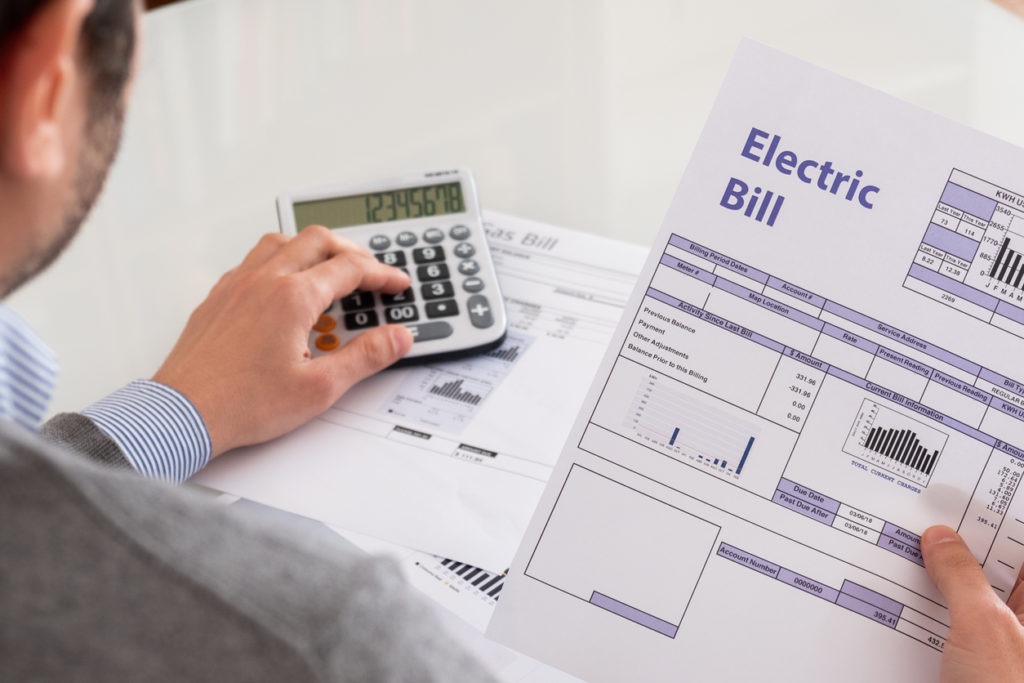
As a subscriber to a Clearway Community Solar farm, once the solar farm is active, customers continue to receive a utility bill but now have an additional, separate bill from Clearway for their solar farm subscription. Wait – why are customers receiving two energy bills?
The short answer is, they aren’t! While a customer’s solar farm subscription supports the generation of renewable solar energy from the solar farm, it is not a subscription for power supply to the customer’s property. The solar power generated by the Community Solar farm goes directly to the power grid, rather than the individual’s property. This is one of the key differences between rooftop solar and community solar.
What is the Community Solar Billing Process?
Clearway’s program is separate from a customer’s utility. Clearway Community Solar is not a utility or a retail electric supplier. When a customer joins a Community Solar program, their energy supply is still provided through their local utility, or through a retail electric supplier if the customer is in a deregulated state and has selected a supplier other than their utility. Therefore, Community Solar customers continue to receive their utility bill as usual. Utility bills include energy supply charges, the distribution charges, and any relevant taxes and fees. The utility is charging customers for the power supply and distribution to their individual property.
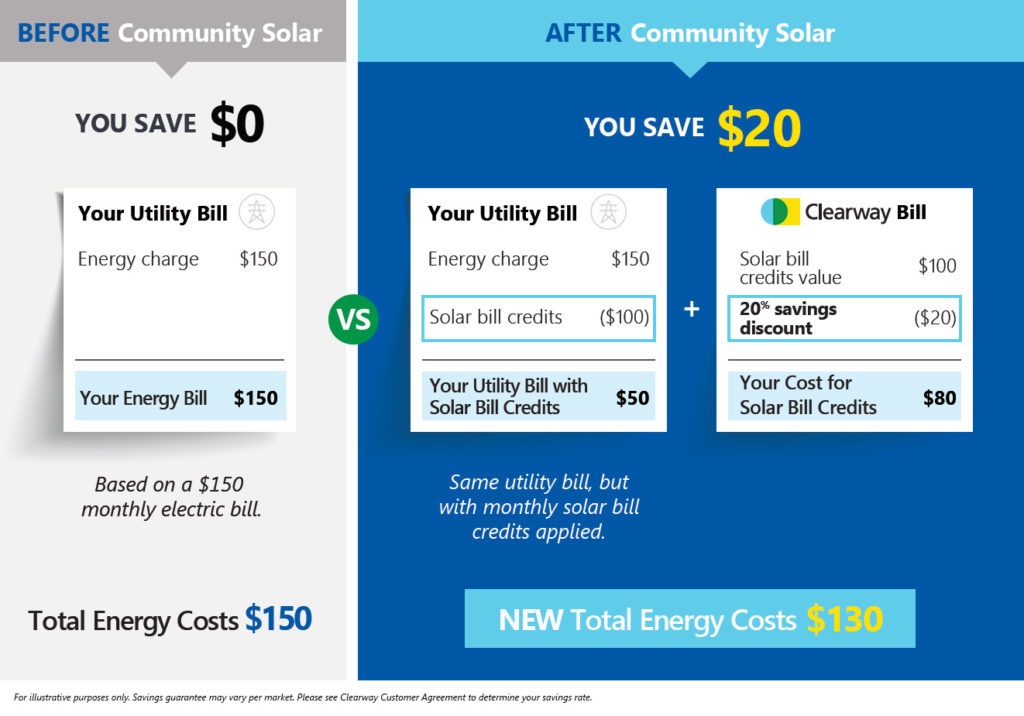
Once a resident or business subscribes to a Community Solar farm, there is one key change: customers start to receive solar bill credits on their utility bill. The solar bill credits vary every month based on the amount of solar energy generated by a customer’s solar farm system size. The utilities are responsible for calculating and allocating the solar bill credits to every Community Solar customer’s utility bill. The utility charges are reduced by the solar bill credits.
By contrast, a customer’s Clearway invoice is not for energy supply, but rather the cost of the solar bill credits themselves. Clearway charges customers for the solar bill credits that were applied to their utility bill, reducing their utility bill. The rate that Clearway charges customers for the solar bill credits is designed to help the customers save on their overall energy costs. Rates may vary by region and offer, and many include a savings guarantee on energy.
In summary, customers, therefore, receive one bill from their utility, with the solar bill credits applied, and a separate bill from Clearway for the cost of the solar bill credits, including any applicable guaranteed discounts. Customers are responsible for paying both invoices, their utility bill to their utility, and their Clearway bill to Clearway. But only one bill is an energy bill, and the other bill is a bill for the solar bill credits that reduce utility charges.
How Can I Breakdown Clearway’s Billing and Savings?
Here’s an easy way to think about Community Solar billing and savings. Imagine if you are going to the grocery store, and you purchased a coupon worth $100. When you check out at your local market, you will get $100 off your grocery bill. Now, imagine that you paid less than $100 for that coupon. For example, sake and illustrative purposes only, let’s say you only paid $80 for that coupon. So let’s break that down one more time: You bought a coupon for your local grocery store for $80, but the value of the coupon was $100, which means you get $100 off your grocery bill. You would have saved $20 on groceries!
Clearway’s Community Solar program works the same way! Every month, you are getting a coupon — an energy coupon that is — applied to your utility bill. The coupon in this case is the “solar bill credit.” Think of your solar bill credits as the coupon to your local grocery store.
The solar bill credits are applied to your utility bill and reduce your charges, just like the coupon to the grocery store reduces your grocery bill.
Just like you must purchase the coupon for the grocery store, you are purchasing the solar bill credits from Clearway in a separate monthly invoice, at the rate specified by your Clearway Customer Agreement.
Let’s Recap
- You subscribe to a Clearway Community Solar farm.
- Your subscription supports the generation of 100% solar energy to the local power grid – this renewable energy replaces polluted power on the grid which means more renewable energy for your state.
- In return for the solar power generated each month, you receive solar bill credits, or “energy coupons”, applied to your utility bill.
- Your utility bill is reduced, you pay less to your utility, thanks to the solar bill credits from Clearway.
- You pay Clearway separately from your utility bill for the cost of the solar bill credits, at your designated rate in your Clearway Customer Agreement.
Will you be using energy for 20 years? Yes! Just like groceries are a necessity that benefit from a discount, so is energy. Clearway’s long-term contract ensures that you receive solar bill credits, or “energy coupons” for 20 years. All the while, you are saving while supporting locally produced, 100% renewable power.
Savings calculated on the value of the solar bill credits generated by the residential solar subscription and varies by region. Clearway is not responsible for utility delays in applying for solar bill credits. Refer to the community solar contract for full agreement terms. Subject to credit approval and 20-year agreement.

Want to learn more about Community Solar?
Our solar specialists can provide a free consultation.
Get Started